The eCommerce Frontline Library: Southeast Asia Region eCommerce Forecast
Southeast Asia Region eCommerce Forecast
Data and expert insight on Southeast Asia regional ecommerce exports forecast through 2030.

Southeast Asia Region Forecast

Article written by James Bledsoe, Director of the eCommerce Solutions Center

The Larger Asia Pacific Region Leads eCommerce Globally

Business-to-business ecommerce for the larger Asia Pacific region has been increasing at 15% on average annually, higher than the global average of 14.5% gross merchandise value growth annually. 
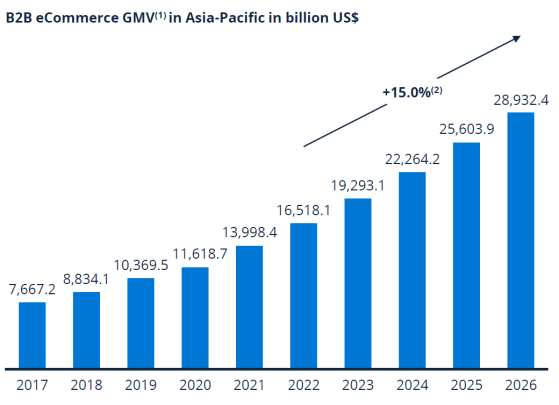
B2B eCommerce Gross Merchandise Value (GMV) in Asia Pacific through 2026
The Asia Pacific region’s ecommerce market value will grow to over USD$28.9 trillion by 2026.

Cross-border ecommerce development varies by individual markets within the Asia Pacific region, with China (71.4) scoring the highest in a ranked development index. South Korea (66.7) and Singapore (65.5) are the next ranked markets on the cross-border ecommerce development index, followed by the Japan (61.1), Thailand (58.8), Malaysia (57.7), and Indonesia (54.3) ecommerce markets.
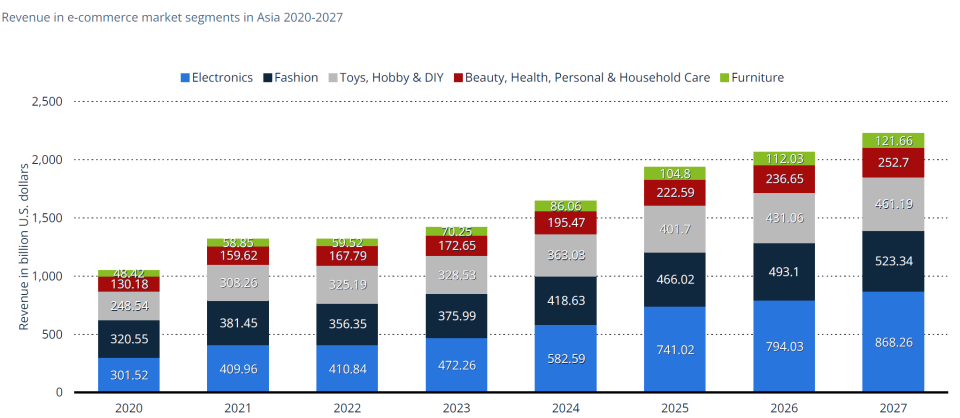
 

eCommerce revenue in Southeast Asia by product segment
eCommerce revenue in Asia from 2020 to 2027 by segment in USD$ billions

Consumer electronics continues to lead the Asia Pacific region’s ecommerce revenue growth, along with the fashion and the toys & hobby segments comprising the majority of the total value of ecommerce sales through 2027.
 

Southeast Asia eCommerce Markets Are Set for Growth

The total internet economy for Southeast Asia is forecast to grow from USD$194 billion to over USD$330 billion by 2025, with Indonesia leading the rest of the region’s markets with an internet economy of over USD$82 billion in 2023.
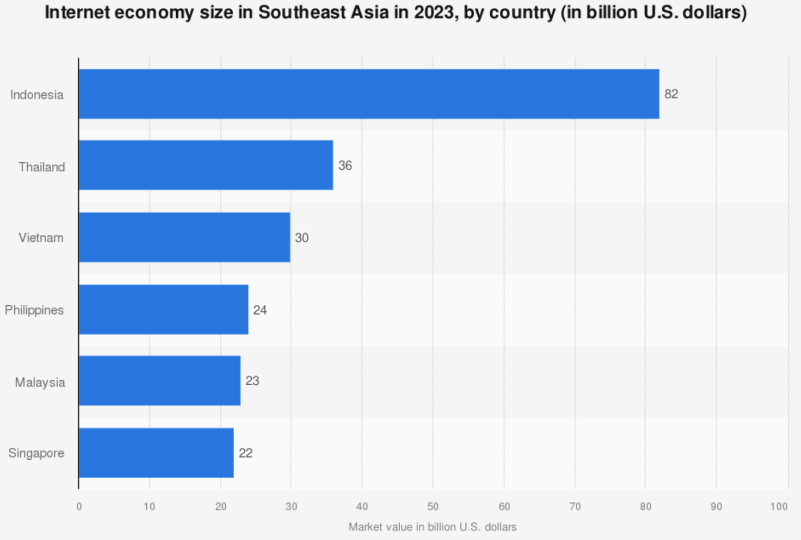
Internet economy size in Southeast Asia in 2023 by country
Chart illustrates Indonesia’s economy size compared to Southeast Asia region neighbors in 2023.

Forecasts for Southeast Asian ecommerce market volumes show significant growth through 2030, with Vietnam, Thailand, and Philippines expected to more than double their ecommerce market values.
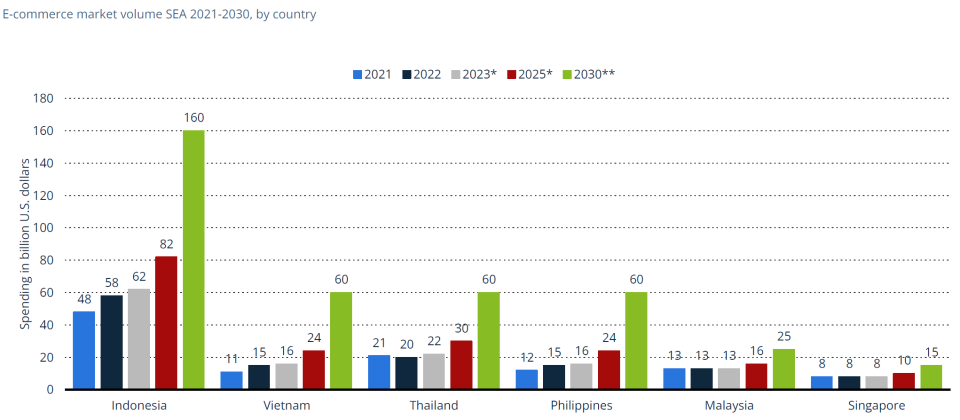
 

eCommerce Market Volume Southeast Asia 2021-2030
eCommerce market volume in Southeast Asia from 2021 to 2030 by country in USD$ billions


Reaching Southeast Asian eCommerce Consumers

Consumers in Southeast Asia predominantly use ecommerce marketplaces (57%) for new product discovery, followed by social media channels (50%), and Google search (40%). It is therefore important to focus on your digital strategy and website search engine optimization to make sure that your business shows up where and when it should for that international online sale.
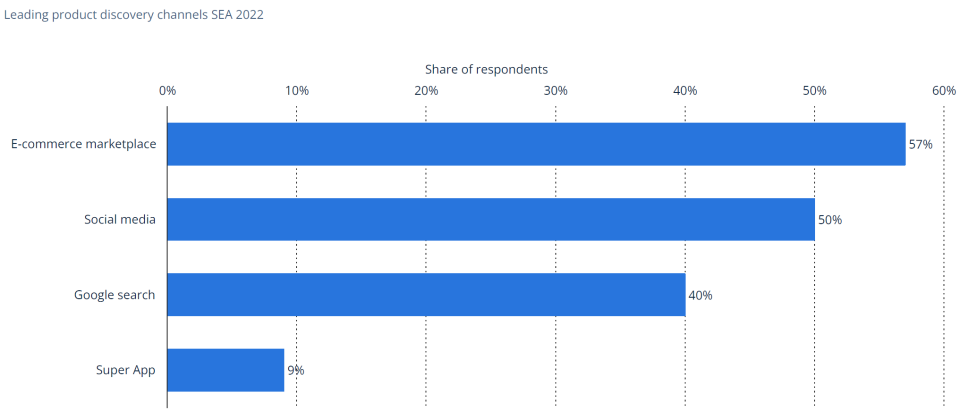
Leading new product digital discovery channels in Southeast Asia
Leading new product “digital discovery” channels in Southeast Asia

Payment methods vary by individual market, with cash payments previously being the most frequently used payment method for ecommerce. Currently credit cards and local online wallets dominate as the preferred ecommerce payment method for Southeast Asia, with a forecast significant increase in both usage and merchandise value being process through these online payment methods through 2026.
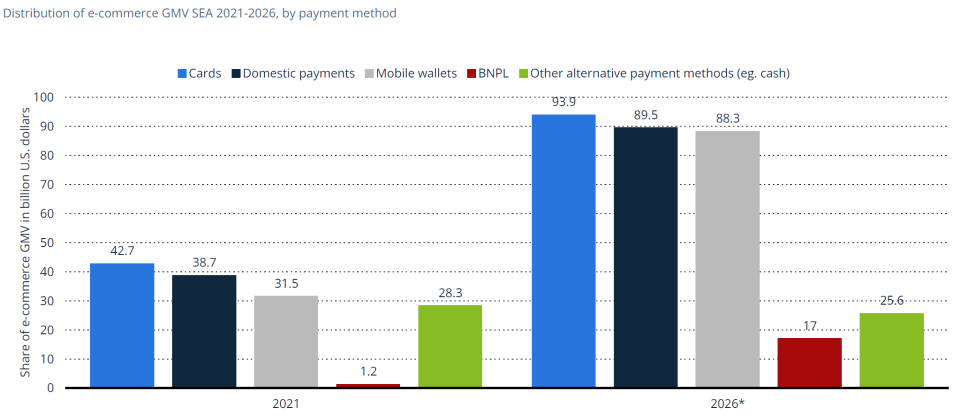
Distribution of ecommerce GMV in Southeast Asia by payment method through 2026
Distribution of value of merchandise in Southeast Asia by payment method in USD$ billion through 2026


European Retail eCommerce ForecastEuropean B2B eCommerce ForecastAfrica eCommerce SpotlightUSMCA Country eCommerce Overview


Return to eCommerce Frontline Library Content


Looking for more ecommerce resources?
The eCommerce Business Service Provider Directory
eCommerce Business Service Provider Directory
Find service provider help with SEO, analytics, digital marketing, website development, IT security, translation, and more.
Cross-border ecommerce generates sales for your B2B and B2C business
Cross-Border eCommerce Business Resources
Improve your online business presence to acquire new overseas consumers.
The WGR Service uses SEO crawls and internationalization best practices
WGR Gap Analysis Service
Is your website search engine optimized to attract overseas consumers? Online customer acquisition begins with a properly functioning website.
Phone Map Tech Download
Business Market Intelligence
Staying informed about business opportunities with international market research is key to successful export planning.
Computer Screen, Flags, and Coins CCG Image
Country Commercial Guide (CCG)
Reports on market conditions, opportunities, regulations, and business customs prepared at U.S. Embassies worldwide by Commerce Department, State Department, and other U.S. Government professionals.
Warm tone library bookshelves
eCommerce Frontline Library
Learn strategies and hone your business tactics for competing and winning in the ultra-competitive frontline of international ecommerce sales.
Finger pointing at button with words "e-commerce"
eCommerce Featured Events
Resource videos on digital strategy to increase online overseas sales.
Rural Export Center
The Rural Export Center (REC)
Start your export journey with customized research and training through the Rural Export Center
eCommerce Solutions Center and US Commercial Service Logo
The eCommerce Solutions Center (ESC)
The eCommerce Solutions Center (ESC) is dedicated to promoting economic growth and supporting opportunity for all U.S. businesses engaged in overseas cross-border ecommerce through its focused support of ecommerce educational outreach events.

×

Global Business Navigator Chatbot Beta

Welcome to the Global Business Navigator, an artificial intelligence (AI) Chatbot from the International Trade Administration (ITA). This tool, currently in beta version testing, is designed to provide general information on the exporting process and the resources available to assist new and experienced U.S. exporters. The Chatbot, developed using Microsoft’s Azure AI services, is trained on ITA’s export-related content and aims to quickly get users the information they need. The Chatbot is intended to make the benefits of exporting more accessible by understanding non-expert language, idiomatic expressions, and foreign languages.

Limitations

As a beta product, the Chatbot is currently being tested and its responses may occasionally produce inaccurate or incomplete information. The Chatbot is trained to decline out of scope or inappropriate requests. The Chatbot’s knowledge is limited to the public information on the Export Solutions web pages of Trade.gov, which covers a wide range of topics on exporting. While it cannot provide responses specific to a company’s product or a specific foreign market, its reference pages will guide you to other relevant government resources and market research. Always double-check the Chatbot’s responses using the provided references or by visiting the Export Solutions web pages on Trade.gov. Do not use its responses as legal or professional advice. Inaccurate advice from the Chatbot would not be a defense to violating any export rules or regulations.

Privacy

The Chatbot does not collect information about users and does not use the contents of users’ chat history to learn new information. All feedback is anonymous. Please do not enter personally identifiable information (PII), sensitive, or proprietary information into the Chatbot. Your conversations will not be connected to other interactions or accounts with ITA. Conversations with the Chatbot may be reviewed to help ITA improve the tool and address harmful, illegal, or otherwise inappropriate questions.

Translation

The Chatbot supports a wide range of languages. Because the Chatbot is trained in English and responses are translated, you should verify the translation. For example, the Chatbot may have difficulty with acronyms, abbreviations, and nuances in a language other than English.

Privacy Program | Information Quality Guidelines | Accessibility