
Capital: Addis Ababa
Population: 113.7million (2022 est.)
GDP (Purchasing Power Parity): $264.05 billion (2020 est., in 2017 dollars)
Currency: Birr (ETB)
Language: Oromo (official working language in the State of Oromiya) 33.8%, Amharic (official national language) 29.3%, Somali (official working language of the State of Sumale) 6.2%, Tigrigna (Tigrinya) (official working language of the State of Tigray) 5.9%, Sidamo 4%, Wolaytta 2.2%, Gurage 2%, Afar (official working language of the State of Afar) 1.7%, Hadiyya 1.7%, Gamo 1.5%, Gedeo 1.3%, Opuuo 1.2%, Kafa 1.1%, other 8.1%, English (major foreign language taught in schools), Arabic (2007 est.)
UNESCO Student Mobility Number
Ethiopia has 8,124 students studying abroad according to UNESCO.
CIA World Factbook
59.28% of the Ethiopian population is under 25 years old.
OVERVIEW
Academic institutions in Ethiopia are growing rapidly creating high potential for students who wants to continue study abroad. Ethiopia followed by Nigeria, Ghana and Kenya ranked fourth among Sub-Saharan Africa countries in sending students to U.S universities.
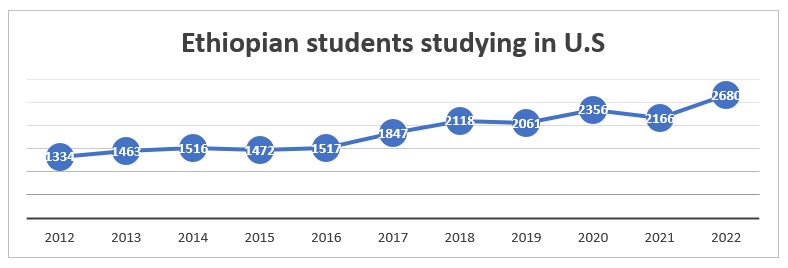
Ethiopian students are most interested in science and technology fields, particularly engineering, computer science, and medicine. This may be influenced by Ethiopia’s 2008 education policy, which dictated that 70 percent of all students pursue science and technology-related degrees, while 30 percent pursue the social sciences. The U.S remains the number one destination for Ethiopian students.
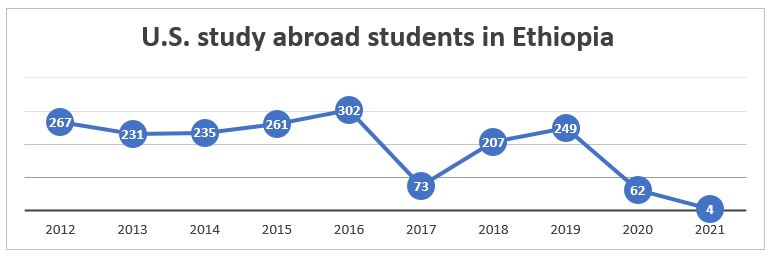
Also, growing number of U.S. study abroad students were registered in Ethiopia over the years.
SUB-SECTORS
|
Students in U.S. by Academic Level |
% |
Number |
% Change (2021 to 2022) |
|
Undergraduate |
64% |
1,705 |
25.6% |
|
Graduate |
23% |
609 |
25.6% |
|
Non-Degree |
2% |
60 |
-36.2% |
|
OPT |
11% |
306 |
33.6% |
OPPORTUNITIES
Individuals’ economic growth is increasing more with peace agreement ongoing, and it is desirable to send ones’ children to the U.S. for education. Most families prefer community colleges because the lower tuition is more affordable.
The existence of many international and private schools in Ethiopia helps recruitment efforts by U.S. higher education institutions.
The U.S. Commercial Service at the U.S. Embassy in Ethiopia can help U.S. education institutions to meet with potential recruitment partners via our customized services, such as Virtual Introductions, Single School Promotions, and the like. There is also an EducationUSA Advising Center in the U.S. Embassy, which helps to assist U.S. higher education institutions in Ethiopia to create a platform for connecting with Ethiopian local students.
DIGITAL MARKETING STRATEGIES
Social media sites such as YouTube, Telegram, WhatsApp, Facebook, Instagram and TikTok are the most popular sites for students in Ethiopia. Students research information via the Internet and via in-person or phone conversations with colleagues and elders. To search for job opportunities, students use print magazines, online job websites, radio, and television. For streaming videos, YouTube, TikTok, and Facebook are most popular.
Local schools in Ethiopia and schools from competitor countries use social media, traditional print ads, their country’s embassy, and recruitment agents to reach students. Students and their parents receive information on educational opportunities through websites and links shared or recommended by friends and family, through social media, through agents, and through their schools.
Recommendations for U.S. education institutions and study consortia to better promote themselves in Ethiopia include: (1) utilize social media and other online platforms that are easily accessible through mobile phones, (2) run intensive ads on national television, (3) participate in networking programs and partnerships with non-profit education institutions.
EVENTS
The Public Affairs Office at the U.S. Embassy organizes education fairs.
RESOURCES
- U.S. Commercial Service - Ethiopia: https://trade.gov/ethiopia
- Federal Democratic Republic of Ethiopia Ministry of Education Website:
- Education USA advising centers in Ethiopia: Addis Ababa
Email: AddisAbaba@educationusa.org
Telephone: +251 111307924/7625
Websites: https://et.usembassy.gov/education-culture/study-usa/ and
https://educationusa.state.gov/centers/educationusa-advising-center-addis-ababa
U.S. COMMERCIAL SERVICE CONTACT
Siraj Mustefa, Commercial Assistant
U.S. Commercial Service – Addis Ababa, Ethiopia
Email: Siraj.Mustefa@trade.gov
Phone: +25 11 1130 7249