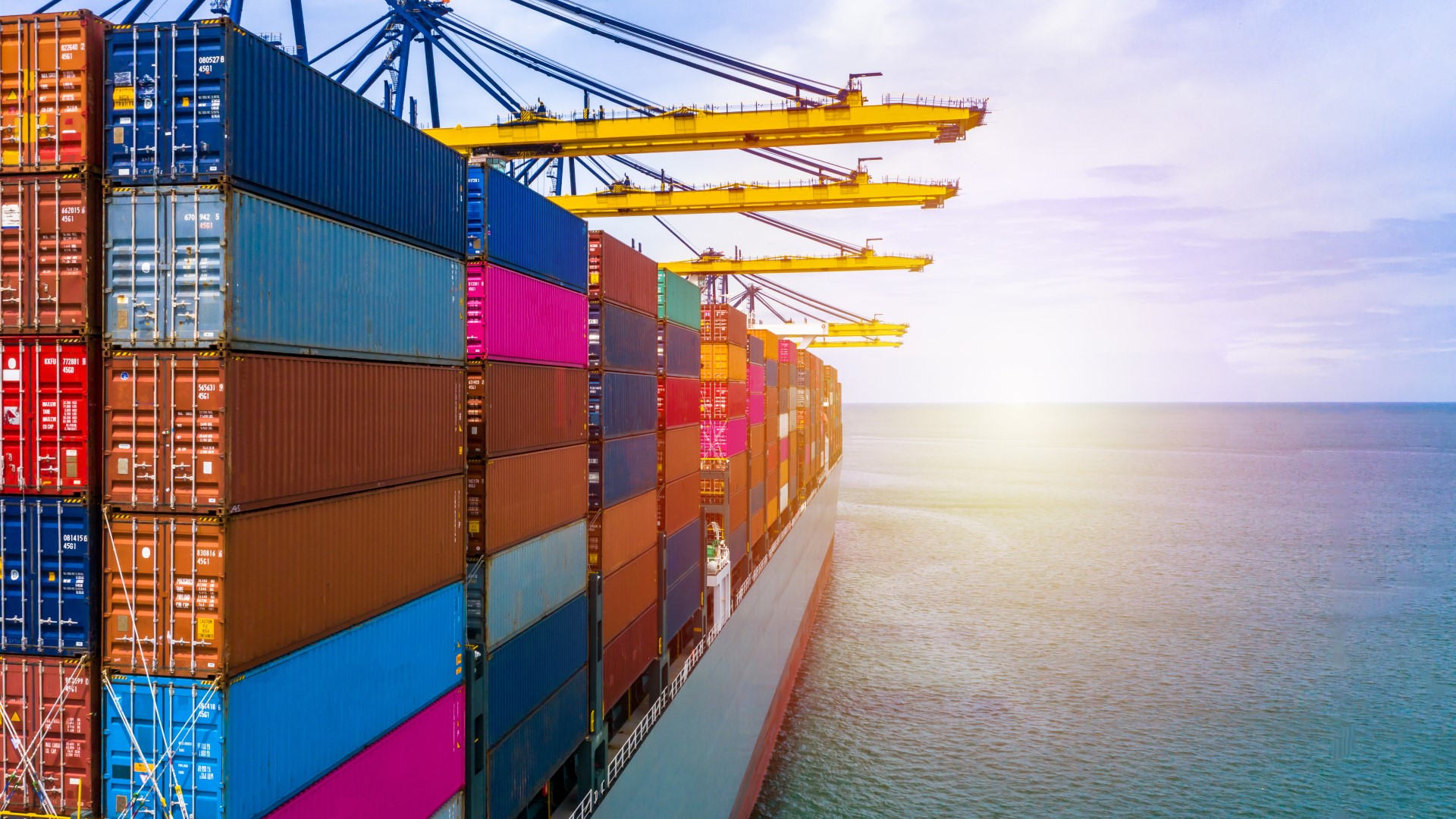
A cargo ship filled with containers in the foreground is positioned under quay cranes, with the ocean stretching out to the horizon and the sun rising and beckoning the container ship to towards its next foray across the open seas
Logistics and Transportation Industry
By investing in the logistics and transportation sector, businesses can better facilitate the flow of goods throughout the world's largest consumer market. 

SelectUSA Logistics and Transportation Industry

Industry Overview

By investing in the logistics and transportation sector, businesses can better facilitate the flow of goods throughout the world’s largest consumer market.  

The logistics and transportation industry in the United States is highly competitive. International and domestic companies in this industry benefit from a highly skilled workforce and relatively low costs. United States business logistics costs reached $2.3 trillion in 2023, representing 8.7 percent of GDP that year. In 2023, foreign direct investment in the industry totaled $155.4 billion.  

Analysts expect investment in the logistics and transportation industry to correlate with other sector-specific growth in the U.S. economy. America’s highly integrated supply chain network links producers and consumers through multiple transportation modes, including air and express delivery services, freight rail, maritime transport, and truck transport. To serve customers efficiently, multinational and domestic firms provide tailored logistics and transportation solutions to ensure coordinated goods movement from origin to end user through each supply chain network segment.  
 

Industry Subsectors


This subsector includes inbound and outbound transportation management, fleet management, warehousing, materials handling, order fulfillment, logistics network design, inventory management, supply and demand planning, third-party logistics management, and other support services. Logistics services are involved at all levels in the planning and execution of the movement of goods. There were 50,045 establishments in the logistics services industry as of 2022, and in mid-2024, there were over 854,000 workers in the industry. Foreign-owned businesses employed 114,200 workers in the industry in 2022. 

Firms in these industries offer expedited, time-sensitive, and end-to-end services for documents, small parcels, and high-value items. Express delivery services (EDS) firms also provide the export infrastructure for many exporters, particularly small and medium-sized businesses that cannot afford to operate their own supply chain. Recent EDS industry growth has been generated by the expansion of electronic commerce use by businesses and consumers. There were 17,033 establishments in the couriers and messengers industry in 2022, and there were almost 1.1 million workers employed in the industry in mid-2024. 

High volumes of heavy cargo and products are transported long distances throughout the United States via rail network. According to the Association of American Railroads, U.S. freight railroads move, on average, around 1.6 billion tons across nearly 140,000 miles of track every year. In mid-2024, there were about 151,000 workers estimated to be employed in the industry.  In 2022, foreign direct investment supported 17,100 jobs in the industry. 

This subsector includes carriers, seaports, terminals, and labor involved in the movement of cargo and passengers by water. Water is the leading transportation mode for U.S.-international freight trade. Ships moved 44.6 percent of the total value and 78.6 percent of the total weight of all freight traded in 2022.  There were 1,780 establishments in the maritime transport industry in 2022, and the latest employment figures estimated that over 75,000 workers were employed in this industry in mid-2024.

Over-the-road transportation of cargo is provided by motor vehicles over short and medium distances. According to the American Trucking Associations, trucking revenues were $987 billion in 2023. Trucks moved 11.18 billion tons of freight in the same year.  

As of 2022, there were 174,556 establishments in the trucking industry, and the latest employment figures estimate that over 1.5 million workers were employed in the industry in mid-2024. Foreign direct investment contributed $873 million to the trucking industry in 2023, and 36,400 workers were employed by foreign-owned businesses in this industry in 2022. 

The warehousing and storage industry includes storage and security for general merchandise, refrigerated goods, and farm products. There were 19,979 establishments in this industry in 2022, and the latest employment figures estimated that there were over 1.7 million workers in this industry in mid-2024. Foreign direct investment contributed $4.7 billion to the warehousing and storage industry in 2023, and 41,100 workers were employed by foreign-owned businesses in 2022. 

world map icon
Industry Factsheet

Explore the impact of foreign direct investment on U.S. jobs, exports, and innovation in the logistics and transportation industry.

document icon
Investor Guide

The Investor Guide is a high-level view of everything from taxes to immigration and workforce to business structures.

chart icon
SelectUSA Stats

SelectUSA has created several dashboards to help analyze key FDI data from a variety of sources.


Company meeting
Industry Associations
A comprehensive list of associations in the logistics and transportation industry.
two hands holding a lightbulb
Incentives
Browse this state incentives database developed by the Council for Community and Economic Research (C2ER).
Person holding phone and computer
Contact Us
Request information and data tailored to your business needs.

×

Global Business Navigator Chatbot Beta

Welcome to the Global Business Navigator, an artificial intelligence (AI) Chatbot from the International Trade Administration (ITA). This tool, currently in beta version testing, is designed to provide general information on the exporting process and the resources available to assist new and experienced U.S. exporters. The Chatbot, developed using Microsoft’s Azure AI services, is trained on ITA’s export-related content and aims to quickly get users the information they need. The Chatbot is intended to make the benefits of exporting more accessible by understanding non-expert language, idiomatic expressions, and foreign languages.

Limitations

As a beta product, the Chatbot is currently being tested and its responses may occasionally produce inaccurate or incomplete information. The Chatbot is trained to decline out of scope or inappropriate requests. The Chatbot’s knowledge is limited to the public information on the Export Solutions web pages of Trade.gov, which covers a wide range of topics on exporting. While it cannot provide responses specific to a company’s product or a specific foreign market, its reference pages will guide you to other relevant government resources and market research. Always double-check the Chatbot’s responses using the provided references or by visiting the Export Solutions web pages on Trade.gov. Do not use its responses as legal or professional advice. Inaccurate advice from the Chatbot would not be a defense to violating any export rules or regulations.

Privacy

The Chatbot does not collect information about users and does not use the contents of users’ chat history to learn new information. All feedback is anonymous. Please do not enter personally identifiable information (PII), sensitive, or proprietary information into the Chatbot. Your conversations will not be connected to other interactions or accounts with ITA. Conversations with the Chatbot may be reviewed to help ITA improve the tool and address harmful, illegal, or otherwise inappropriate questions.

Translation

The Chatbot supports a wide range of languages. Because the Chatbot is trained in English and responses are translated, you should verify the translation. For example, the Chatbot may have difficulty with acronyms, abbreviations, and nuances in a language other than English.

Privacy Program | Information Quality Guidelines | Accessibility