
charts and graphs overlaying a commercial airplane
Aerospace Data Tips & Sources
Learn how to customize the aerospace and defense data visualization tools to get the most out of them for your firm. And learn about our data sources.

Aerospace Data Help Page

Aerospace & Defense Data Tools - Frequently Asked Questions

How Do I Access Tooltips?
Hover over a data point (bar, line, dot) on a graph or chart. PowerBI needs a second to start rendering them, and you may need to move the cursor slightly vertically to trigger it.

How Do I Clear/Reset the Selections Within a Slicer/Filter?
With the slicer in focus (click in it) click the little eraser icon in the upper right corner.
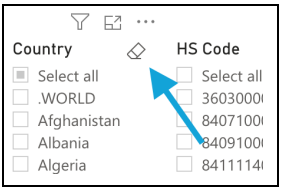
aerospace data slicer showing how to reset by clicking on the erasure icon
Data Slicer

How Do I Export Data?
In the toolbar for the report (at the top of the page), click on the first and/or second icons to see available export options (pdf, ppt, excel, etc).

Data toolbar with export and expand table options
Data Tooltip

Watch the Help Video

Aerospace Data Visualization Help Video

What Are the Data Sources Used for This Tool?

  • Trade Flow Tab:  General Imports and Total Exports - USDOC, Bureau of the Census, Foreign Trade Division.
  • M3 Aircraft and Parts Shipments Tab: Defense and Non-Defense Aircraft and Parts, NAICS - USDOC, Bureau of the Census (https://www.census.gov/manufacturing/m3/historical_data/index.html).
  • Employment Tab:   Employment, Hours, and Earnings from the Current Employment Statistics Survey, Bureau of Labor Statistics, (https://data.bls.gov/cgi-bin/srgate) Series ID: CEU3133640001 and CEU3133460006.
  • Defense Total Exports Tab:  USDOC, Bureau of the Census, Foreign Trade Division.

×

Global Business Navigator Chatbot Beta

Welcome to the Global Business Navigator, an artificial intelligence (AI) Chatbot from the International Trade Administration (ITA). This tool, currently in beta version testing, is designed to provide general information on the exporting process and the resources available to assist new and experienced U.S. exporters. The Chatbot, developed using Microsoft’s Azure AI services, is trained on ITA’s export-related content and aims to quickly get users the information they need. The Chatbot is intended to make the benefits of exporting more accessible by understanding non-expert language, idiomatic expressions, and foreign languages.

Limitations

As a beta product, the Chatbot is currently being tested and its responses may occasionally produce inaccurate or incomplete information. The Chatbot is trained to decline out of scope or inappropriate requests. The Chatbot’s knowledge is limited to the public information on the Export Solutions web pages of Trade.gov, which covers a wide range of topics on exporting. While it cannot provide responses specific to a company’s product or a specific foreign market, its reference pages will guide you to other relevant government resources and market research. Always double-check the Chatbot’s responses using the provided references or by visiting the Export Solutions web pages on Trade.gov. Do not use its responses as legal or professional advice. Inaccurate advice from the Chatbot would not be a defense to violating any export rules or regulations.

Privacy

The Chatbot does not collect information about users and does not use the contents of users’ chat history to learn new information. All feedback is anonymous. Please do not enter personally identifiable information (PII), sensitive, or proprietary information into the Chatbot. Your conversations will not be connected to other interactions or accounts with ITA. Conversations with the Chatbot may be reviewed to help ITA improve the tool and address harmful, illegal, or otherwise inappropriate questions.

Translation

The Chatbot supports a wide range of languages. Because the Chatbot is trained in English and responses are translated, you should verify the translation. For example, the Chatbot may have difficulty with acronyms, abbreviations, and nuances in a language other than English.

Privacy Program | Information Quality Guidelines | Accessibility